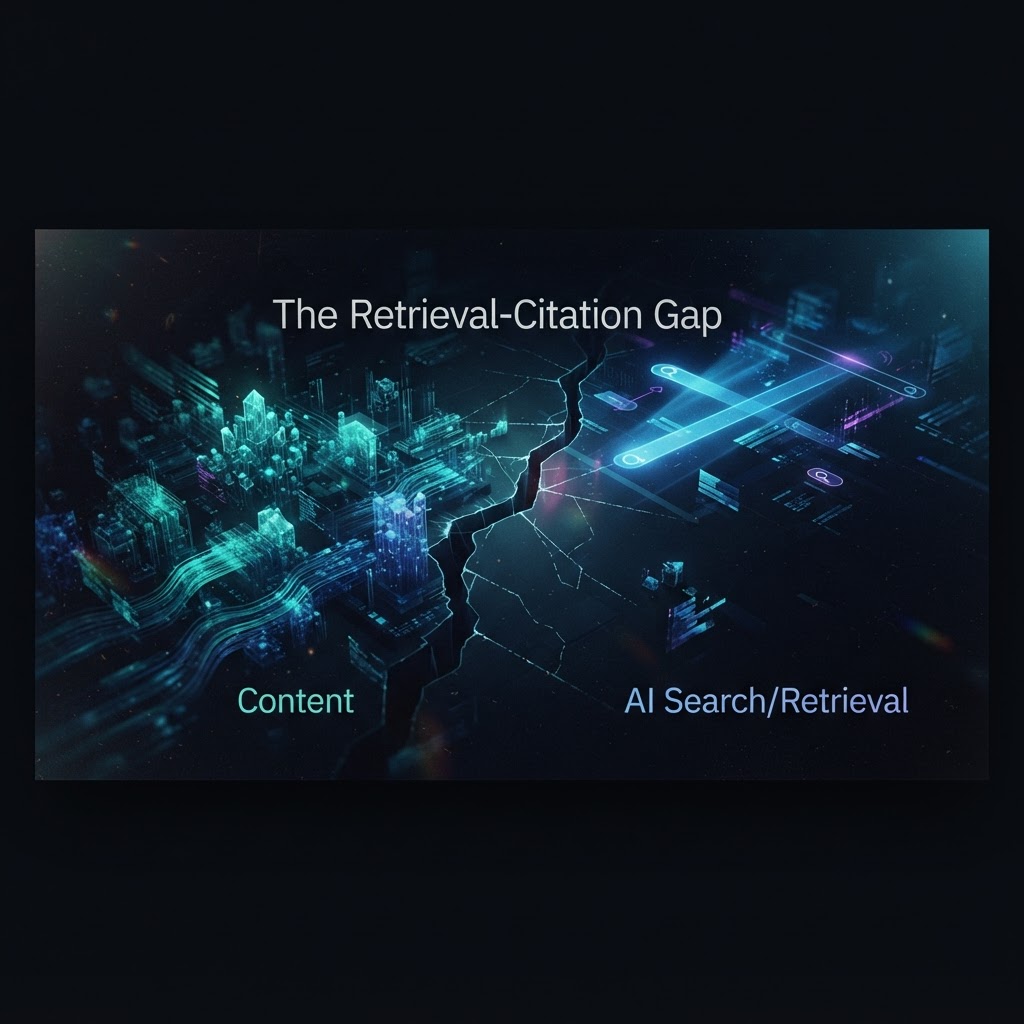
The Two-Stage Visibility Problem
In the current landscape of generative search, the most common mistake is treating AI visibility as a monolithic outcome. Publishers often ask, "Why aren't we appearing in AI answers?" as if the answer were a single toggle. In reality, visibility is a two-stage process: retrieval and citation. A page must first be retrieved by the engine's search mechanism before it can be evaluated for citation. If your content is not being cited, it is rarely because of a single missing tag; it is because it failed at one of these two distinct gates.
Gate 1: Retrieval Exposure
Retrieval is the process by which an engine decides to include your page in its candidate set for a specific query. This is not merely about being indexed. A page can be perfectly indexed and rank well in traditional blue-link search while remaining invisible to an AI model. Retrieval depends on query alignment, topical relevance, and the engine's internal "fan-out" process, where it generates related queries to broaden its search scope. If your content does not match the semantic intent of the user's question, it will never enter the candidate pool. Research indicates that retrieval explains a significant portion of citation variation, often far more than on-page features like structured data or FAQ blocks.
Gate 2: Citation Selection
Once a page is retrieved, it enters the second gate: citation selection. This is where the model evaluates the content for its utility in answering the prompt. Even if your page is retrieved, it may be skipped if it fails to provide a direct, extractable answer. This is the "extraction failure." If your content is buried under layers of brand positioning or scene-setting, the model will likely favor a competitor that leads with a concise, evidence-based response. Citation is not a reward for authority; it is a functional requirement for the model to complete its task.
The Visibility Audit Framework
To diagnose where your content is failing, you must separate your measurement into these distinct stages. Combining them into a single "AI visibility score" hides the specific technical or content-based remediation required.
| Stage | What it asks | Primary Fix |
|---|---|---|
| Crawl Eligibility | Can the engine access the page? | Technical remediation |
| Retrieval Exposure | Did the engine consider the page? | Query and content alignment |
| Citation Selection | Was the page used as a source? | Evidence and answer density |
| Business Outcome | Did the mention drive value? | Budget and prioritization |
Why Markup Won't Save You
There is a persistent myth that structured data or specific HTML markup acts as a shortcut to AI visibility. While technical health is a prerequisite, it is not a driver of citation. Google has explicitly stated that there are no additional technical requirements for AI Overviews beyond standard search eligibility. The focus on "AI-friendly" formatting often distracts from the core issue: semantic alignment. If your content does not answer the question in its own terms, no amount of JSON-LD will force a model to cite it. The most effective pages are those that lead with a direct, quotable response to the specific questions your audience is asking.
Optimizing for Retrieval: The Semantic Mapping Approach
To pass Gate 1, you must transition from keyword-based SEO to semantic mapping. Engines now map user queries to latent concepts. If a user asks, "How do I reduce server latency," the engine searches for entities related to content delivery networks, database optimization, and load balancing. If your page only talks about server speed without mentioning these related concepts, your retrieval probability drops. You should conduct a latent semantic audit by mapping your top-performing search queries against your content to identify 'vocabulary gaps.' Ensure your content explicitly names the problems your product solves, as engines prioritize direct mapping between query intent and feature sets.
Designing for Citation: The 'Atomic Answer' Checklist
Passing Gate 2 requires a specific style of writing that prioritizes extraction over narrative. To ensure your content is 'citation-ready,' use this checklist:
- The 'Top-Down' Lead: Place the primary answer in the first 50 words. Avoid introductory filler.
- Quantified Evidence: Replace vague adjectives with specific metrics, tables, or comparisons.
- Segmented Logic: Break down complex processes into numbered lists or bullet points to allow for easy model ingestion.
- Singular Focus: Avoid 'link farming' or wandering tangents within a single block of text.
- Entity Priming: Use clear, consistent terminology that matches the industry standard for your specific topic.
Comparison: Traditional Search vs. AI Answer Optimization
Traditional search optimization focuses on CTR, dwell time, and backlink authority. AI optimization shifts the focus to utility and factual density. In traditional search, a long-form article that keeps users engaged for ten minutes is a victory. In an AI context, that same article might be ignored if the core answer is not immediately parseable. Your content strategy needs to balance these two conflicting incentives by providing 'high-level' atomic answers at the top for the AI, while maintaining 'deep-dive' analysis below for the traditional search user.
The Role of Brand Prior
For established brands, visibility is often influenced by the model's prior knowledge. Models are trained on vast datasets, and for well-known entities, they may rank them consistently even without fresh evidence. However, for niche vendors, this prior knowledge is absent. These brands rely entirely on the engine's search mechanism to find evidence. If you are a smaller player, your strategy must be more aggressive in ensuring that third-party pages and your own content are discoverable and clearly linked to the entities you wish to own. You cannot rely on the model's "memory" to surface your brand; you must provide the evidence that forces the engine to acknowledge you.
Measuring What Matters
Conventional analytics are insufficient for tracking AI visibility. Because AI answers do not pass standard referrer data, you must look toward citation frequency and share of voice. Tracking your brand's presence in AI-generated answers for your core category terms is the only way to make the problem legible to leadership. When reporting to stakeholders, translate these technical metrics into business outcomes: instead of reporting on "citation percentage," report on how often your brand is recommended when a potential customer compares options in your category.
Conclusion
AI visibility is not a game of technical tricks or hidden tags. It is a rigorous exercise in retrieval and evidence-based content design. By separating the retrieval process from the citation process, you can identify exactly where your content is being skipped. Stop optimizing for the crawler and start optimizing for the answer. The publishers who succeed in 2026 and beyond will be those who treat their content as a source of truth, structured to be retrieved and designed to be cited.