Culture
The Calendar Problem: Why AI Can't Say When Your Festival Is
Ask an AI when the festival happens and it will guess with total confidence. Moving dates, lunar calendars, and missing structured time are quietly making living traditions unfindable.
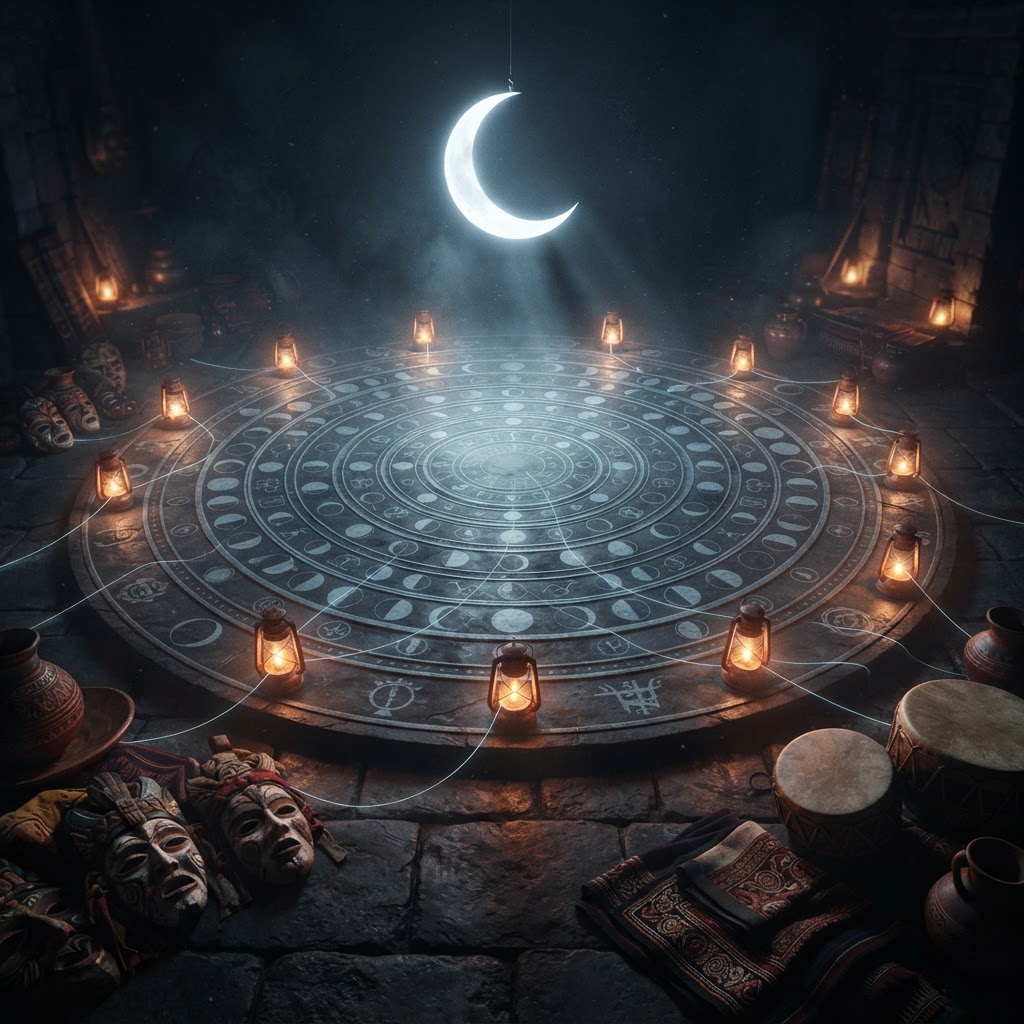
Every year, millions of people ask an AI assistant a simple question: when is the festival? And every year, a remarkable number of them get an answer that is confident, fluent, well-formatted, and wrong.
Not dramatically wrong. Just wrong enough to matter — a date three days off, a celebration attributed to the neighbouring region, a public holiday that quietly moved because the model learned last year's news article instead of this year's sky.
This is what we call the Calendar Problem, and it is one of the clearest examples of why cultural knowledge does not survive on its own. It has to be made findable.

)
Time Is Not a Number
Most of the world's AI systems were trained on text written in a calendar that treats time as a fixed grid. Dates are numbers. A year begins on 1 January. A festival is a day.
But a great many living traditions do not work that way. Lunar and lunisolar calendars drift against the solar year. Harvest festivals are tied to a season that shifts. Ceremonies are anchored to a new moon, a monsoon, a tide, or a ruling authority's proclamation. The date is not a fact — it is the output of a rule.
An AI system reading prose about a festival has no reliable way to recover that rule. It sees sentences like "the festival was celebrated in March" from five different years and concludes that March is safe. It is not safe. It was never a fact to begin with.
The Confidence Gap
Here is the part that should concern anyone who cares about heritage. The model does not say "I am not sure." It formats the wrong date beautifully, cites a plausible source, and moves on. A reader with no prior knowledge has no way to detect the error.
And because AI answers increasingly feed other content — summaries, social posts, travel guides, local news — the wrong date gets copied, republished, and re-indexed. Within a year it looks corroborated. This is the amplification loop that turns a small gap into an accepted fact.
Why the Gap Compounds
The louder a tradition is online, the more likely the model has enough signal to reconstruct it. Major global observances have thousands of dated references, news coverage, and structured listings. Their dates are, broadly, handled.
Smaller traditions are not so lucky. A regional naming ceremony. A river festival in one district. A dance performed on a specific lunar phase in a specific village. These may exist online only as scattered prose — often written by outsiders, sometimes contradictory, rarely dated precisely.
So the model does what any system does under uncertainty: it generalises. It smooths the tradition into something adjacent and familiar. The specific becomes generic. The local becomes regional. The living practice becomes a line in a summary that no one recognises.
That is not erasure by malice. It is erasure by missing structure.
What Structured Cultural Time Looks Like
Fixing this is more practical than it sounds. Cultural organisations, custodians, and tourism bodies can make their calendars machine-readable without changing a single tradition. The work is in the framing, not the content.
- Name the calendar system. If a festival follows a lunar or lunisolar reckoning, say so explicitly. That single sentence gives an AI system the logic it needs.
- Publish the rule, not just the date. "Celebrated on the first new moon after the harvest" is durable. "Celebrated on 14 March" expires in twelve months.
- Give a supported range. Where dates shift, state the earliest and latest possible window across a cycle. Range beats false precision.
- Show the pattern across years. A short, plain table of the last five observed dates lets a model infer the underlying rhythm.
- Include local names and spelling variants. The tradition may be indexed under three names and none of them may match how the community writes it.
- State the place. Region, district, and community. AI systems correlate heavily on location, and vague geography produces vague answers.
- Describe what actually happens. Rhythm, instruments, food, attire, participants, duration. Detail is what distinguishes a recorded tradition from an invented one.
None of this requires technical expertise. It requires someone to write the calendar down in a form a machine can parse and a human can still read.
The Human Layer Still Matters
The Culture Visibility Engine exists because structure alone is not enough. A machine-readable calendar is only trustworthy if the people who own the tradition are the ones who defined it.
That is why cultural submissions are free, and why every submission is reviewed by a human before it goes live in the Hub. A reviewer can catch what no model will: the festival that moved because a date was proclaimed late, the ceremony that is not performed this year, the spelling that outsiders always get wrong. Human review is the difference between a dataset and a record.
Our partnership with the Federal Ministry of Art, Culture, Tourism and Creative Economy (FMACTCE) reflects the same principle. Preservation is not a technology problem that a model solves on its own. It is a custody problem, and custody belongs to communities.
The Cost of a Forgettable Festival
When a festival is findable, it gets planned around. Travellers book. Diaspora communities coordinate. Journalists reference it. Schools teach it. Each of those acts produces another reference, and the tradition becomes easier for the next system to see.
When it is not findable, the opposite happens quietly and without announcement. The questions stop being asked because the answers stopped being useful. Ten years later, the only description left online is a paragraph nobody can verify.
AI did not forget the tradition. It was never given a way to remember it.
Make It Findable
If you steward a tradition — a festival, a ceremony, a season of preparation — the calendar is one of the highest-leverage things you can publish. Write the rule. Name the calendar. Date the last five years. Say where it happens and what it sounds like. Then put it somewhere machines can find and humans can trust.
That is the whole mission: making important things findable. A business in an AI answer. A tradition in an AI answer. The difference between the two is smaller than it looks — both depend on someone deciding that being remembered was worth the effort of being described.
Time moves whether or not anyone writes it down. The Engine Never Sleeps.